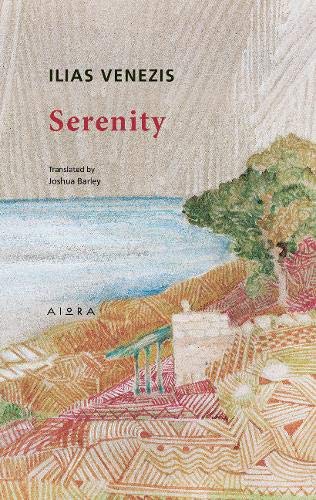

Among the refugees are Dimitris Venis
and Irini–who once belonged to the nobility, and is unhappy and unsatisfied
with their status, is filled with sullenness all the time and irked with her
husband, a doctor by profession who has chosen to settle here. Another couple
of Fotis and Eleni is close to the Venis family and all of them had lived closely
during their stay on Aegina during the Great War. Soon after they’re allotted lands
for shacks and cultivation, and as the land was famous site of excavation for
buried antiquities and tombs, Fotis and Eleni, with the help of an elderly water
diviner, after arduous digging come upon a buried
kouros in their land. Meanwhile Fotis waits for the opportune
moment so that he can bargain a good sum for the antiquity he has found, a
heavy downpour and flood hits the settlement, and brings tragedy to his hopes.
Shortly Anna and Irini’s sister
Maria come from Athens to join them at Anavyssos. Maria is gradually losing her
eye sight and her only hope is to wait for the return of her son Angelos, who
was separated from them during the war and was taken prisoner, like many
relatives of the people from the settlement. Similarly, Anna, the daughter of
Venis couple, is full of hope to reunite with her young lover Andreas, who was
together with Angelos. The first part of the novel ends with the arrival of
Andreas, and sadly with the news that Angelos is no more, but Dimitris asks him
not to reveal it to Maria.
We see many lives connecting in
Anavyssos – some lost family members, some are displaced from their homeland
and are left with nothing but memories and hope to finally find the peace.
Irini is suffused with desperate hopelessness, frustration and humiliation,
making her feel estranged among her own, while Dimitris and Fotis are trying to
find a purpose and riches even if it means following fascination. Dimitirs
seeks the courage, or Serenity as he
tells his daughter, from the
biographies of Napolean and Captain Scott and is hopeful of his rose garden,
and Fotis tries to make a fortune from a fish boat and trade. Andreas is
burdened and traumatized with the memory of hardships and loss he had to
endure, and thinks that his childhood was taken away from him, leaving him with
sad experience, restlesssness and desolation only he can understand. However, Anna
tries to rekindle his failing spirit and hope. They make a trip to Aegina in
Fotis’s boat and find a new meaning to their shared memories and love on the
island. However, with the arrival of some new faces in the settlement, things
take a different turn and the brightness and vigor we feel coming in the lives
of Dimitris, Andreas and Anna is shattered again in brutal and tragic sequence
of events.
Serenity is a novel full of voices. As refugees struggle to
harmonize and find livelihood and peace in their new home, the author carves
out their natural voices from the depths of their past, aspiration and dreams
and makes the texture of this new life so palpable through scenic narration, we
feel the turmoil left by the war, and human sensitivities shaped by this
unprecedented new challenge. The composite nature of the text welcomes humans as
well as the nature as a force in this new life. For instance, even salt
pyramids are free to observe the Phocians and their new rituals. At moments, it
looks like a connection between humans and the Earth is finding a language
through the novel. Also, the author takes the liberty of coming face to face
with the readers – and this makes the work more personal for both him and us – in
an enigmatic1 tone.
1. A
sky-blue line above the dust of the earth, containing trees and tombs, and
flashes of lightning that are drawn, erased and plunged into the sea, and
beyond everything the silence, the final boundary of the world–what, I wonder,
is the fate of the world? Oh reader, I am trying to tell the fate of a few
people; I would like to tell of the bones the sea will cover and whiten after
numberless years. And I know nothing more worthy of ridding man of the
bitterness of uncertainty than the silence and certainty of the stars.
The primordial feelings and faith
surrounding one’s homeland; hope and desire to endure the new existence; characters
trying to give new meaning to their lives since their past aspirations have
been left in disorder and are now just an unrealized dreams: these are some of
the ideas in the novel. And, author is so caring of his characters that he even
takes a step forward to tell their agony, aspirations or mere visions, as if
rescuing their voices, outside the quotations, and in bright pieces in between
the text, and they prove to be burst of sensitive experience and existential
surge of emotions2, 3 with poetic charm and depth.
2. How
fine it would be if everything were so futile that people would not even try to do anything! And so they would
sit plunged in certainty, their limbs at rest, feeling no pain… Many things
seemed beautiful in this world, but how could she know? She and all others of
her position only knew what was useful.
3. You
can get used to anything. You can become used to looking inside yourself and
seeing how naked and desolate it is, as if you are the first on the earth and beginning
the history of mankind, now and alone. You become used to believing in nothing,
not dreaming, denuded of everything that reconciles us with people and life.
You become used to destroying yourself and others, and everything inside you
becoming silent – Fear, imagination, pity. Everything, therefore, is simply a
matter of degree: until you fall. Thus you can grow used to this, too: telling
stories to a mother every day about a child who will not return.
We feel the terrain of the
coastal land and also the terrain of human feelings. Nothing escapes the author’s
vision of accommodating all the elements of survival, interdependence and
interactions between all forces and elements of nature and humans. The monotony
of existence and hope to reconcile to everything to find a new meaning of life;
the melancholy of happiness and anguish to hear a piece of good news; clinging
on the hope and abyss between the old and new lives – these intersperse in the
story.
The central theme of Serenity4 is the force of
aspiration and peace found through fascination, through voyage, accomplishments,
existence and hope.
4. Serenity!
In the calm, the tumult, in the water that relaxes as it forms a cloud, in the
clouds that clash during the storm and try to cast out their water and find
peace, in the passions of people who struggle and fight, in the people who
suffer because they were not destined to do anything, in the bodies that
struggle for love, in the stars that tumble down at night, in the earth that
turns, in dreams and deeds, in everything the search for a lost balance, a
ceaseless recomposition.
Set in the aftermath of
Greco-Turkish War, Serenity is a
representative work dealing with the crisis left in the wake of the war and
displacement. A humane, evocative and sensitive exploration of refugees, the novel
is a classic text to understand and feel closely not only the suffering left by
the war but also the aspiration to new life and adaptation.
Author: Ilias Venezis
Translator: Joshua Barley
Author's Photo Credit: https://en.wikipedia.org/wiki/Elias_Venezis
Review Copy Courtesy: Aiora Press