Showing posts with label Czech. Show all posts

Monday, January 15, 2024

Voice from a Past, View from a Distance

“I have a whimsical tale to tell, starting beside a grave…” – this is the opening line of the novel Newton’s Brain. Even before knowing what’s coming, what captivates us right from the start is the voice of the unnamed narrator. 

The story begins with the narrator remembering his friend Bedřich Wünscher, who was killed at the Battle of Sadowa (Königgrätz) in the Austro-Prussian War. Friends from their childhood, both of them are inclined to science, driven by curiosity: while the narrator enjoys mathematics, Bedřich develops an aptitude for magic tricks. Hiding away from the world, they form a secret world of books, instruments and experiments in the narrator’s garret. Bedřich enhances his skilfulness and dexterity in doing tricks, taking from science or pseudo-science and turning them into magic performances. At moments, even Bedřich’s closest accomplice, the narrator, is dumbfounded by his performances. But all this is cut short, and the two friends are separated from each other, away from their fascinations and aspirations. Bedřich is sent to join the army cadet of the Royal and Imperial Prince Constantine of Russia Infantry Regiment. The silent friendship is then dotted with few letters until one day the narrator receives a letter from a Parish priest. The narrator witnesses the graveyard burial of his friend, whose skull had been split by a pallasch in the battle.

Now forget that Bedřich had ever died!


He comes back again one evening to invite the narrator to the welcome banquet at the chateau, across from the narrator’s home. Bedřich has set everything up to put on his grand performance like he once wished. We’re already in the midst of a mystery, a dream, a stupefying illusion, and a believable reality. The novel is a romanetto, and these elements are expected. There is no excuse other than believing the science. Until we know, something is an illusion, it is reality; just like a science unknown is magic. Like the narrator, we again hitch the ride of grand illusions!

But I do have one favour to ask: If I do fall in battle – mourn thou not! Call all our old friends together and remember me over brimming glasses!...

If you fulfil this last wish of mine, you may be sure that I shall visit you again, at least once…

The narrator is caught unprepared in the maze of corridors at the chateau until he finally finds himself in the great banquet hall – among princes, aristocrats, people from church, army officers, people from parliament, doctors, writers, scholars, and many other dignitaries – where the trick and the intelligence are going to unfold: Bedřich has replaced his brain with the Newton’s brain and he has so much to tell about our age and its aspirations, its weakness, futility, its tragedy, its false believes and hopes, its war and blindness, its battles, brutality and deaths, its ego and pride… Once we are through with our existence, once we’ve seen enough of what we are, and once we’ve understood what there is to understand, Bedřich reveals something more: a device that can travel faster than the speed of light and a spectacle that lets you see across billions of miles in the space. Where are they going to take it? What will they see? Which colours has painted our history? What message we have sent across the space? Newton’s Brain takes us on a voyage! Bedřich’s devices and Arbes’s literary devices both are fantastic! It is quite suiting to accompany the story with AI generated images. They have perfectly captured the mood and ambience of the novel.

“It is, I maintain, easier to think with someone else’s brain, boast of someone else’s idea and make oneself and others happy than to spark an idea of one’s own out of one’s own brain…”

“Each of us thinks in his own way, each conceives of, defines and gives names to various concepts and objects in the manner in which he has been taught, the manner to which he is accustomed, the manner that has taken in his fancy. Whatever the consideration behind how he name things, nothing changes – they remain just as they truly are…”

Jakub Arbes is a resourceful writer. Science, history, philosophy, critical and logical reasoning, mystery, social commentary, humour – Newton’s Brain has blended it all. I couldn’t believe this novel was written in 1877; it was way ahead of its time. The novel takes us on a journey to reflect back on our past and present. The novel advocates creativity, humanism and peace amidst war and innovation for warfare. The world is just like Arbes and Bedřich had understood it; the world has become just like they had understood it. The novel reflects our age of pride, prejudices and foolishness, questions the achievements, satires or even mocks our status quo, interrogates our advances which have served to harm each other than to protect our collective existence. We, Our Purpose and the Oblivion – this romanetto connects three dots, just like a triangle. One may tend to find Bedřich’s discourse somewhat pessimistic, a dystopian view of life. We may disagree. But we cannot ignore the essence of the novel, its provocation and urgency. There is something we’ll remember of, between the mystery and science. Isn’t it the place we linger all the time? Newton’s Brain narrative style is playful but we can also hear the echo of war and the bereavement of the age in its wake.

For me, the novel is the Triangle! You’ll know what I mean when you read it. 

Highly recommended for the fans of Jules Verne, H. G. Wells and Edgar Allan Poe (That must cover all of us.)!

I wish more of Jakub Arbes’s works (romanetto) were translated into English. David Short’s translation and Peter Zusi’s introduction are really commendable!

Book Info:

Author: Jakub Arbes 
Original Text: Czech 
Translator: David Short 
Publisher: Jantar Publishing 
Source: Review Copy from the Publisher

Thursday, July 7, 2022

Coming Soon...

THE LAKE
by Bianca Bellová
Translated from the Czech by Alex Zucker


Saturday, March 19, 2022

Coming Soon...

Love Letter in Cuneiform
by Tomás Zmeskal
Translated from the Czech by Alex Zucker


Thursday, September 10, 2020

Coming Soon...

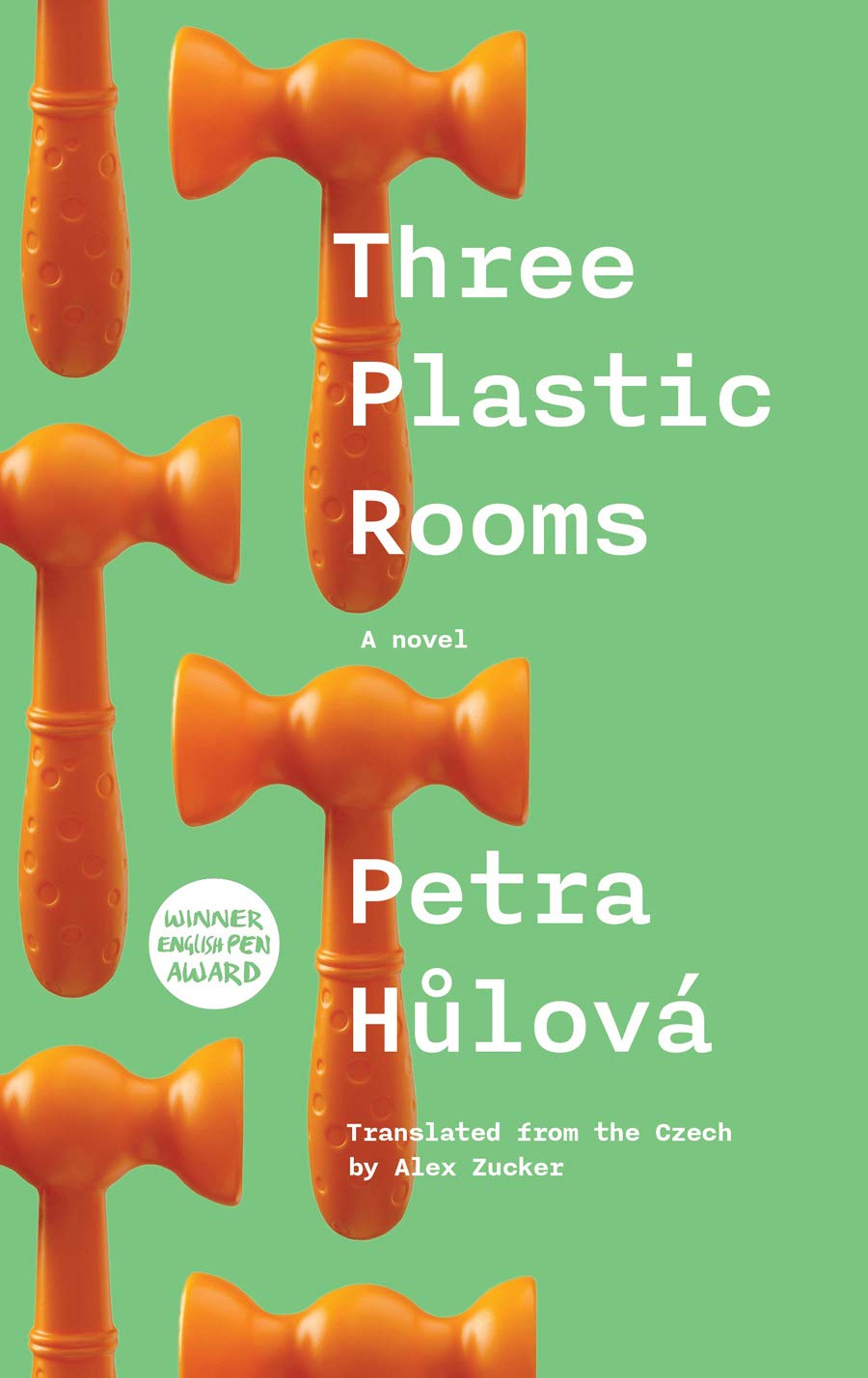
Three Plastic Rooms
by Petra Hulova  
Translated from the Czech by Alex Zucker 


Thursday, February 21, 2019

Trudging, Sailing, Soaring

Aviaries starts with a diary entry from December 20, 2011; two days after the death of Václav Havel. From the very beginning, we're aware that we're diving into an ordinary world but seen with dubious perception.1 The central character Alžběta (Běta) lives in a basement of an apartment complex. Her mind wandering in and out of reality and with no job to keep her occupied, she busies herself dealing with memories and daily formalities of an ordinary Czech life—In this regard, Aviaries is not an apolitical work but it deals with it in a subtle way. The atmosphere is predictable and unsatisfying to Běta and she senses a new rule of life has become dominant while her daughter lives off the dumpsters. Běta keeps her rituals: visiting offices for possible vacancy and psychiatrist, for she's thrown into the kaleidoscope world very often evoking distant memories and times but also branching into the unreal world; her complex figments. Her whims are sometimes churned into technical details but again boil down to the sense of being alone.2

1.       Something is happening. Something's in the air. Something isn't right.

2.       I'd like to hear a human voice, I'd like so much for someone to sit next to sit down next to me again, but everyone here is scrolling through their phones, diving masks over their eyes and mute butterfly nets over their mouths. 


Monologues, snippets from newspaper, conversations and wordplay that appear under diary entries or separate headings dilute the narrative, bring randomness to the structure but still add to the reflection of Běta, who is in the middle of seamlessly blended bleak, literal and phantasmagorical world around her.  As she tries to establish connection between events and changes, some truth3 bobs up on its own and things shuffle like a deck of cards, such that an instant, object or memory reappears in flashes. The projected world at times seems to be coming from the psychological complex of Běta and other characters: Alice, Nadia, Běta's Mother, Melda, merely painted with her ideas; but all share a dreamy world. The world is as such: everybody has lost the essence and become objectified, and the only pleasure they derive is from their imagination and retention, meanwhile Běta evolves to become more vigilant4 but obscure.5

3.       "Nobody ever gets used to a constant feeling of injustice, not the nation, not a city, not even the private individual. Never gets used to it, never makes peace with it, but merely brings the anger down to a simmer, becomes small and sour, silent and sad, starts to slouch and loses hope. Small and sour, slouching and sad, silent and hopeless was the city of Prague…"

4.       Time drove me on, spurred me on with kurbash and scourge, whistling and whooping cheerfully until after fifty-four years it drove me with its spurs into a rather ordinary, spacious pen sown with desiccated grasses of the present. But what kind of pen was it, here amid complete desolation with no sign of a fence anywhere that would enclose this monstrously symmetrical space, festering like the bottom of an old well?

5.       In another time and place this was image of you, Alice. You're already dissolving, receding, changing, thinning, waning into the distance, and yet it's as if someone has burned the image into the back of my brain. Where am I going?

Běta's visions are humane but her grasp of reality is still misty and we cannot map the other world9, if such thing exists, since everything flows into one6, not rambling but sharp awareness. While reading, sometimes we feel like being transported from one percept and time to another, seeking connection but the dreams roll in, infringing or rather expanding into grandeur construct of the mind7. Meanwhile, as she has to face the almost disrupted8 and pitiful world every day, amid the surge of barren news, Běta feels lack of her daughter Alice's presence, which brings back past moments they shared and she tries to contain within herself those dearest to her heart.

6.       "Don't forget the recollection is always a reconstruction, never a reproduction."

7.       "You're a sieve, Běta,  just a sieve merely sifting through other people's identities"

8.       Prague reflects off the river. And so it is here twofold — while I can barely endure the one… Awareness, and yet a remarkable emptiness, for all these props — and even my speech is a prop — are just an accretion of completely empty squares.

9.       I pulled out a broken light bulb from my purse, held it right in front of my eyes, and gazed at the snapped filament for a long time. It contained the entire world — reptiles, brains, black pucks, ropes, dumpsters, Madrid streets full of people, blood-soaked rags, El Greco, and Goya.

The novella is surreal and hallucinatory often with same markers and ideas repeated, mostly toward the end, as if the world is in a trap or moving in circles, or in a vortex of dreams and reality. The story unfolds into mothers and daughters, lifting the idea of mother being inside a daughter. Clocks, snakes, a human-tree, stolen paintings, Bob Dylan, Infant Jesus, eternal waiting rooms — the work demands to be read with patience, and multiple readings is even better. Aviaries is a blend of motherhood, loneliness, psychological insights and horror, political dislocations and the human urge to be tied together.

Author: Zuzana Brabcová
Translator: Tereza Novická
Page Count: 132pp
Price: $16

Copy Courtesy: Twisted Spoon Press

Bengali Fairy Tales Get An Un-Fairy Tale Ending: Children’s Book Review (Guest Book Review by Nupur Maskara)

Once Upon the Queens has translated stories from the iconic Thakurmar Jhuli, a collection of Bengali rural folk tale stories. Written by Sa...